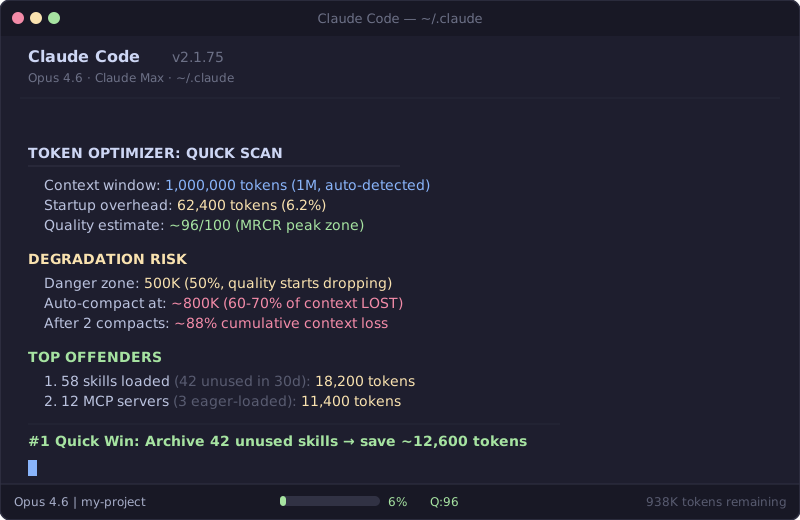
Token Optimizer cuts the tokens you waste and keeps the work you would otherwise lose. It audits your setup for waste, compresses new content as it enters your context, checkpoints your session before compaction destroys it, and tracks every token and dollar on a dashboard that updates after each session. It runs fully local, with zero baseline context overhead and zero runtime dependencies.
It works today on Claude Code (CLI and VS Code), OpenCode, OpenClaw, Codex, Hermes, and GitHub Copilot (CLI and VS Code, beta). Each platform has its own native plugin. Windsurf and Cursor are on the roadmap.
Command-output compressors touch roughly 15 to 25% of your context on a good day. The other 75 to 85%, plus the 60 to 70% you lose on every compaction, goes untouched. Token waste comes in three kinds, and a tool that fixes one leaves the rest on the table.
Structural waste
A bloated CLAUDE.md, unused skills, duplicate system reminders, stale MEMORY.md, entries past line 200 the model never sees, dead MCP servers. Often the largest share, and it compounds: a leaner prefix means a smaller cache-read bill on every turn that follows.
Runtime waste
Verbose command output, oversized MCP results, and re-read files that flood your context mid-session. This is the slice proxy compressors handle.
Behavioral waste
The habits that quietly burn tokens: letting the cache expire, compacting too late, looping on a failing approach, running Opus where Haiku would do. Some are caught live in the session; others only show up across many.
Token Optimizer covers all three. And because it checkpoints your session before compaction fires and restores what the summary dropped, the savings stick instead of vanishing the moment auto-compact kicks in. Read the full model in How it works.
A one-time audit. Run /token-optimizer after install. It produces a per-component token breakdown, fixes what it safely can, and recommends the rest. See Reading your first audit.
Active compression, automatic. Delta re-reads, code-skeleton substitution, and bash-output compression cut runtime waste as it enters your window, all on by default.
Compaction survival. Checkpoints before auto-compact, restore after, and a digest of large tool outputs so the model does not re-read from scratch.
A live dashboard. Per-turn token and cost breakdown across four pricing tiers, quality grades, subagent spend, skill adoption, and a savings tracker. It regenerates after every session.
A quality score. A 0 to 100 grade that tracks how much the session has degraded, turn by turn, in the terminal status line and on the dashboard.