
Benchmarks
Every number Token Optimizer publishes comes from local production telemetry, and every measurement tool ships in the repo. You can regenerate every figure against your own sessions. This page covers the methodology, the fixture suite, and the reproduction commands.
What it saved
Section titled “What it saved”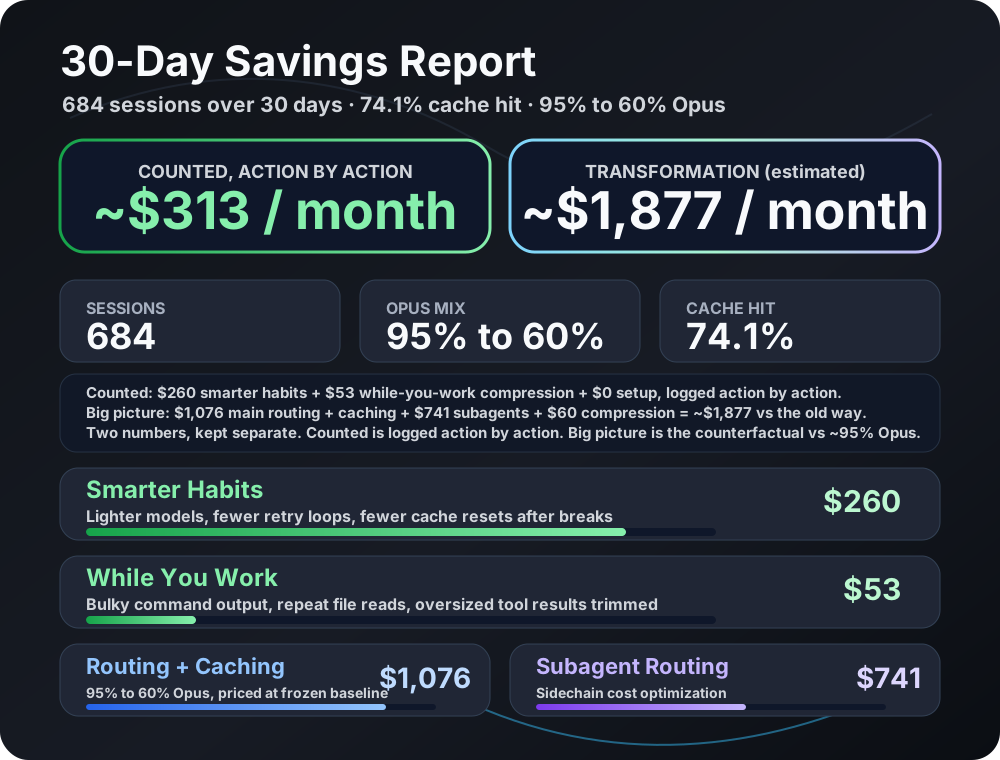
Two numbers, kept separate on purpose. One is directly metered (every event logged). The other estimates your full transformation. Figures are one user’s 30 days (snapshot ending 2026-06-15); yours will differ, and the dashboard computes your own from your own sessions.
| 30-day savings | What it is | |
|---|---|---|
| Measured | ~$313/mo | Savings logged event by event. The proven floor. |
| Transformation | ~$1,877/mo (~18%) | Your whole workload, priced the old way versus now. Estimated. |
Measured, ~$313
Section titled “Measured, ~$313”| Source | 30-day | How it was measured |
|---|---|---|
| Model routing (realized) | $260 | Every turn that ran on a lighter model than your baseline, priced at the real rate cards. |
| Compression | $53 | Every output shrunk or evicted, logged with before and after token counts. |
Transformation, ~$1,877
Section titled “Transformation, ~$1,877”A current-volume counterfactual: your exact 30-day volume held constant, priced the way you work now versus the way you worked before Token Optimizer. Because the volume is identical on both arms, the gap is pure efficiency, never confounded by workload growth. It sums three non-overlapping pools (caching lives inside pool 1).
| Pool | 30-day | |
|---|---|---|
| Main routing + caching | $1,076 | billed volume at current mix versus baseline mix; cache-write is a routing lever; no outlier drop |
| Subagent (sidechain) routing | $741 | a separate sidechain pool, a documented gap on hosts without Claude-style sidechains (OpenClaw, OpenCode) |
| Compression add-back | $60 | metered removals repriced at the baseline input mix, disjoint from the billed pool |
| Total | ~$1,877 |
Combined actual is about $8,708/month; combined old-way about $10,585/month. Baseline Opus share 0.95, current 0.60. The measured routing ($260) is the proven slice of pool 1, never added on top. The measured compression ($53) is the floor of the $60 add-back. Pricing is at Opus 4.8 rates: $5/MTok input, $25/MTok output, $0.50/MTok cache-read.
Trust tiers
Section titled “Trust tiers”Token Optimizer never sums different kinds of evidence into one number. Each table is labeled with its tier.
| Tier | Meaning |
|---|---|
| Measured | Directly metered: realized model routing plus runtime compression events |
| Estimated | The counterfactual transformation, grounded in the user’s own behavior |
| Opportunity | Realizable if the user acts on an audit recommendation; never folded into the headline |
Two relationships keep the tiers from double-counting. The measured routing overlaps the transformation’s pool-1 routing lever: it is the proven slice of the same model-mix shift, reported as a floor and never added on top. The measured compression is the proven floor of the compression add-back: the headline reprices those same metered dollars to the baseline input mix, so the measured figure and the headline contribution are the floor and the repriced value of one quantity, not two savings.
Prompt-cache savings (cache_read) are never claimed as standalone Token Optimizer savings; the cache is free infrastructure. Inside pool 1 the counterfactual does redistribute caching at the baseline pool-hit rate, which is the modeled effect of lighter sessions, not a claim on the cache discount itself.
Baseline mix and platform parity
Section titled “Baseline mix and platform parity”The before-arm model mix is gated so a baseline is never fabricated. An Anthropic user with a measured frozen baseline is priced at that baseline; an Anthropic user with no baseline is priced at the 0.95 Opus owner default only after a one-time consent, otherwise at the user’s own current mix. Non-Anthropic platforms (Codex, Hermes, Copilot, OpenClaw, OpenCode) are always priced at the user’s own measured mix, never a fabricated Opus share.
A parallel effort ports this methodology to OpenClaw and OpenCode (TypeScript). On those platforms the subagent pool is a documented platform gap: they have no Claude-style sidechain transcripts, so that pool reads zero rather than being estimated.
The fixture suite
Section titled “The fixture suite”The compression benchmark validates that compression preserves what the model needs. The suite holds 87 fixtures across 22 categories. Each fixture defines raw output, a must-preserve list, a must-not-contain list (which catches hallucination), and a minimum compression ratio. A fixture passes only when all three checks hold.
| Category | Fixtures | What it tests |
|---|---|---|
| test_exts | 10 | test-runner variants across file extensions |
| build | 8 | cargo, make, webpack, tsc, gradle |
| git | 7 | status, log, diff, merge conflicts |
| lint | 7 | eslint, ruff, clippy, pylint |
| logs | 7 | nginx, docker, systemd, application |
| tee_on_failure | 5 | failed commands keep full output |
| json | 4 | value-preserving structured compression |
| csv | 4 | columnar compression |
| stack_trace | 4 | frame-limited tracebacks |
| cloud_cli | 4 | aws, gcloud, az output |
| search_results | 4 | grep and web search condensed to top hits |
| security | 3 | AWS keys, GitHub PATs, Slack tokens (must NOT be stripped) |
| tree | 3 | nested directory structures |
| progress | 3 | download and install progress bars |
| list | 3 | long listings |
| k8s | 3 | kubectl output |
| test_runner | 2 | pytest, jest, go test |
| error | 2 | non-zero exit, permission denied (must pass through raw) |
| package_install | 1 | pip and package managers |
| directory_listing | 1 | large ls output |
| npm_install | 1 | npm ci and install |
| test | 1 | generic test output |
The security fixtures are the load-bearing safety check: they verify credentials survive compression intact. Compression never removes what the model needs to see, and never strips a secret.
The production corpus
Section titled “The production corpus”| Measure | Value |
|---|---|
| Quality-scored sessions | 684 (30 days) · 2,042 all-time |
| Sessions with file reads | 5,814 (backfill corpus for skeleton analysis) |
| First-reads analyzed | 30,771 |
| Benchmark fixtures | 87 across 22 categories |
| Average prompt-cache hit rate | 74.1% |
The two corpora are distinct populations, not double-counted. The backfill corpus is larger because it includes historical sessions recovered from file-read logs. The production figures come from Claude Code CLI sessions, the author’s primary platform. Quality scoring and savings tracking work on all platforms, but the signal count varies by platform (3 to 7 signals).
Live compression results (30 days)
Section titled “Live compression results (30 days)”This is the directly-metered compression tier: output Token Optimizer shrank or evicted as the sessions actually ran.
| Mechanism | Events | Tokens removed | Saved |
|---|---|---|---|
| Tool-output archive | 646 | 9.31M | $27.91 |
| Lean session resumes | 7 | 3.22M | $16.11 |
| Structure maps (re-reads) | 307 | 1.19M | $5.37 |
| Checkpoint restores | 24 | 0.71M | $3.35 |
| Delta reads | 6 | 5.9K | $0.03 |
| Total | 990 | 14.44M | $52.77 |
This is the metered floor (a 30-day snapshot ending 2026-06-15; your dashboard recomputes it live, so your numbers will differ). The headline transformation adds model routing and lighter sessions on top, as described above.
Output-token reduction (estimated tier)
Section titled “Output-token reduction (estimated tier)”Every row above is input-side: context Token Optimizer removed before it reached the model. One feature works on the other, more expensive side of the bill. The Lean-Output Nudge fires when context fills past 25%, regardless of context quality: a short, cache-safe note (injected as additionalContext, never rewriting the existing prefix) tells the model to reason deeply but keep its visible output lean. The reduction is estimated at 10 to 15%, not measured. The counterfactual (what the model would have written without the nudge) cannot be observed, so this figure is an assumption recorded in the estimated tier and is never summed into the metered totals above. Every nudge does record the session’s pre-nudge average output tokens, so a future calibration can compare actual post-nudge output against that baseline.
This sits in the estimated tier, not the metered floor, on purpose. Output tokens are billed at $25/MTok on Opus, five times the input rate, so the lever is large, but the counterfactual (how many tokens the model would have produced without the nudge) is modeled per session rather than metered event by event. The feature also shipped after the 2026-06-15 snapshot, so it contributes nothing to the measured and transformation figures on this page; your dashboard meters it forward from your own sessions.
Behavioral savers (metered, low-volume)
Section titled “Behavioral savers (metered, low-volume)”Two features prevent waste instead of removing it, and both log a savings event when they fire. Quality Nudges surface a one-line warning when context quality drops, so you compact before degradation compounds. Loop Detection flags the agent repeating the same failing action before it burns more turns. Each is priced from the turn content it prevents (quality_nudge, loop_detection), but both are low-volume by design and add little to the 30-day floor above. Their payoff is avoided degradation and avoided retry loops, not a headline dollar figure.
First-read skeleton promotion
Section titled “First-read skeleton promotion”Large code files on first read that are unlikely to be edited soon are served as a skeleton, with the full original archived and retrievable via expand, a ranged Read, or a direct Edit. A cohort (language plus size band) is only promoted to active serving after proof from real history: the edit-within-5-turns rate must stay under 15% across 20 or more reads in 5 or more distinct sessions.
A live tripwire watches every active cohort. If a cohort’s live edit-after-skeleton rate ever crosses 15%, it auto-demotes to measure-only and logs a cohort_demoted event. Demotions are sticky to prevent flapping; re-promotion is explicit (measure.py cohorts promote <lang:band>) or happens on the next history backfill. The full original is always archived before any skeleton is served, and if archiving fails the full file is served unchanged (fail-open).
As of v5.11.27 the active cohorts are code only — Python (16-64KB, 64-256KB) and TypeScript (16-64KB, 64-256KB), four in total, of which TypeScript 64-256KB graduated by interpolation (zero edits in history plus a passing adjacent band) and is judged on a smaller tripwire floor that the dashboard flags. Markdown cohorts were demoted to measure-only: a headings-only outline drops load-bearing prose, and the edit-rate gate does not capture whether the prose itself was needed. The two controlling flags are visible and toggleable in measure.py v5 status.
Quality grades
Section titled “Quality grades”The 7-signal quality score rolls up to an S/A/B/C/D/F grade. Across the last 30 days (684 sessions):
| Grade | Sessions | Reading |
|---|---|---|
| S | 27 | Exceptional: minimal waste, high decision density |
| A | 144 | Good: clean context, efficient tool use |
| B | 225 | Normal: some bloat, recoverable |
| C | 79 | Degraded: significant waste, coaching recommended |
| D | 209 | Poor: heavy bloat, likely retries or loops |
| F | 0 | Failing: near-total waste (none observed in this corpus) |
All 2,042 sessions are graded on the same scale all-time. The grade scale is identical on every platform, so grades compare across hosts even when the underlying signal count differs.
Reproducing the numbers
Section titled “Reproducing the numbers”Run any of these against your own data. Results will differ based on your usage; that is the point.
# Fixture suite (validates compression quality)python3 scripts/benchmark.pypython3 scripts/benchmark.py --json
# Historical corpus replay (first-read skeleton analysis)python3 scripts/compression_backfill.pypython3 scripts/compression_backfill.py --limit 100 --json
# Structure-map proof from your own transcriptspython3 scripts/measure.py structure-proofpython3 scripts/measure.py structure-proof --torture
# Live compression stats (from your history database)python3 scripts/measure.py compression-statspython3 scripts/measure.py compression-stats --days 7 --json
# Cohort status and tripwire statepython3 scripts/measure.py cohorts status --json
# Full dashboard (all layers visualized)python3 scripts/measure.py dashboard
The --write-cohorts and --write-events flags on compression_backfill.py promote validated cohorts and write events to the history database; without them the backfill is read-only analysis.
Token counting
Section titled “Token counting”Token counts use a bytes / 4 BPE proxy, which carries roughly 15% error versus actual Claude tokenization. The proxy is applied consistently across every measurement, so before/after ratios are reliable even where the absolute count is approximate.
Known measurement gaps
Section titled “Known measurement gaps”These are documented because honest measurement says where it is uncertain.
- Opus fast-mode cost is under-counted by roughly 50%. Fast mode is billed at 2x the standard rate but is not exposed in session JSONL, the statusline input, or settings. Fast-mode sessions are priced at the standard rate until the transcript exposes the mode, so their real cost is understated.
- Cache-health waste is an opportunity-tier estimate. The cache-report headline is built from a prefix-rewrite heuristic because JSONL does not expose cache-key identity. Run
cache-report --verboseto break the headline down by affected session, with the widest waste-triggering gap and re-written token count per session, so any disputed figure traces to its source. - Keep-Warm savings are a projection, not realized dollars. The dollar figure is the shipping policy replayed over real pause history, not a separate model. On a subscription machine Keep-Warm stays off, so no dollars are realized and the figure reads as projected.
For the full methodology including the per-provider cache profile registry and the Keep-Warm honesty rules, see the repository’s BENCHMARK.md.